




UX design improves navigation, usability, page speed, and customer satisfaction, making visitors more likely to complete purchases or inquiries.
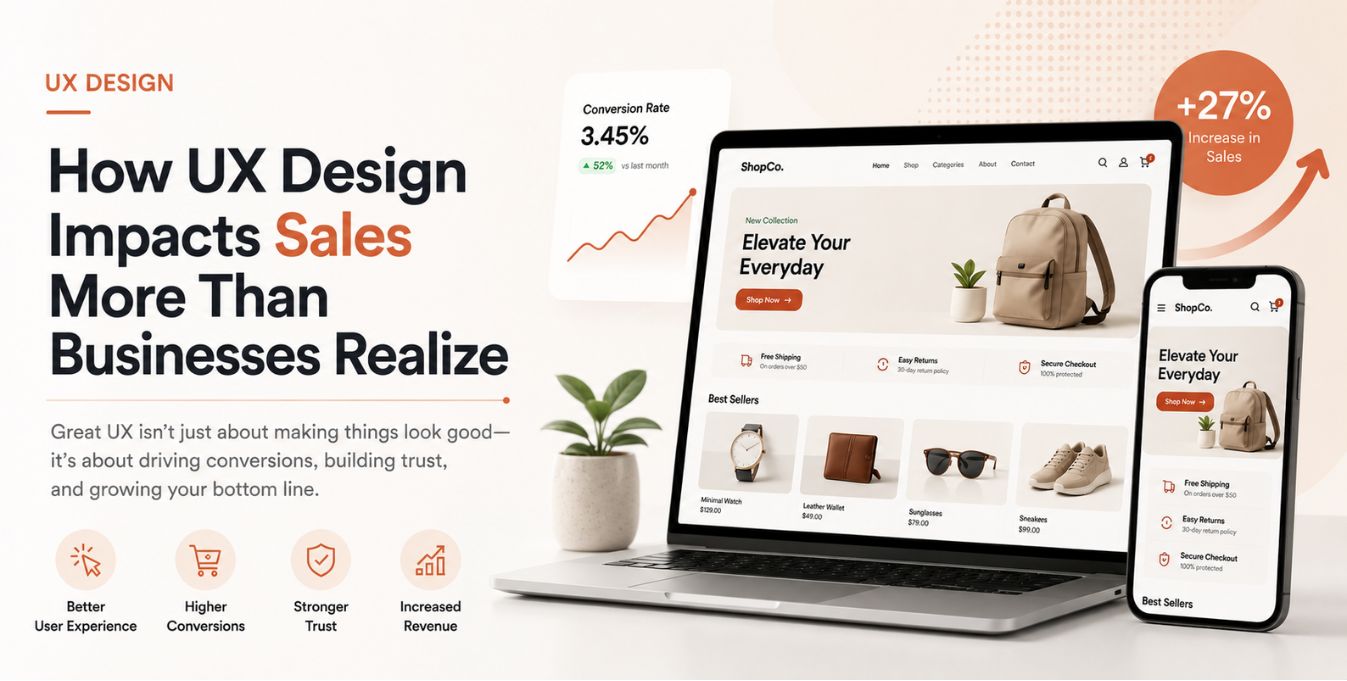
UX means user experience design of a website or an app. UX simply tells how users engage with a digital platform. This aspect of the website or app highlights the navigation, responsiveness, usability, and the overall experience of customers. Maintaining a good UX score is hence essential for all businesses.
Many businesses blame their advertising strategies, low traffic, or heavy competition for declining sales. However, they overlook UX design, the simplest reason that can disrupt sales. The fact is that businesses don't face a decline in sales or customers because of poor products, but because of poor user experience. A slow website, poorly designed app, difficult navigation, a confusing layout, or cluttered interface are examples of poor UX design that can damage the reputation and conversion of the business without them getting the slightest hint.
A slow website, difficult navigation, cluttered interface, confusing checkout process, or poor mobile responsiveness can significantly reduce conversions. Even the best digital marketing campaigns struggle to generate results when users encounter friction throughout their journey.
If your business is investing in digital marketing, it is equally important to understand how website conversion optimization strategies and user experience contribute to sales growth.
Why Does UX Design Hold So Much Importance?
In the present times, when attention spans have dropped to less than three seconds, and internet users have become highly impatient, it is apparent that brands need to maintain a good UX score. Users expect the web pages to load quickly, act smoothly during online shopping or transactions, and feel spontaneous. However, if the experience is frustrating, slow, or full of errors, users just abandon the site. This implies a loss for one brand and a gain for the other.
Google research data proves that 53% of mobile users are likely to abandon websites or shopping carts that take more than three seconds to load. Hence, a well-designed user experience contributes to a higher conversion rate and positive imagery of the brand.
UX design is henceforth the most important factor that influences online growth.
A well-designed user experience helps businesses:
- Increase conversion rates
- Reduce bounce rates
- Improve customer satisfaction
- Strengthen brand credibility
- Encourage repeat purchases
- Support long-term business growth
Google has consistently emphasized page experience and usability as important ranking signals. Businesses looking to improve organic visibility should also focus on building an SEO-friendly website that provides a seamless user experience.
UX Design vs Visual Design
People often confuse UX design with visual design because 'design' is a common factor. Though they sound similar, both are poles apart. Visual design is limited to aesthetics, while UX design means a lot more. A good-looking website or app may be visually appealing, but if it is not usable, it accounts for a bad experience. UX pivots on the usability of a website or app according to these factors:
- Can users quickly find the information they are looking for
- How easy is the app/website navigation
- Does the web page/app allow smooth actions
- How do users emotionally perceive and experience the platform
A good UX design removes complications in taking action. This can be understood via these examples:
- A well-designed and quick-loading mobile app might leave customers with a bad experience because of confusing navigation.
- A modern, sophisticated shopping site may still risk losing customers because of steps that confuse during checkout.
- A visually striking service website may impact inquiries due to hidden contact details.
Businesses often invest heavily in aesthetics while overlooking usability. A beautiful website without strong UX is similar to a luxury store without clear signage—it may look impressive, but it still loses customers.
If you're planning a redesign, reviewing a comprehensive website redesign guide can help ensure both aesthetics and usability are properly balanced.
Most Common UX Mistakes that Businesses Make
Brands unknowingly damage their brand imagery through minor UX issues, which can be avoided. Here are the most common ones:
- Generic message: If your website has unclear headlines or poor guidelines, it is bound to confuse users. Website sections must highlight the benefits of products/services that users will invest in. Not doing so unknowingly harms the brand imagery and results in loss of sales.
- Overloaded homepage: Users seek clarity. Brands that try to communicate a lot of things at once create a chaotic user experience. Hence, the communication and layout of the homepage should be simple.
- Not prioritizing mobile optimization: Web pages or shopping apps are accessed on mobile devices more than ever. Businesses should hence prioritize optimizing for mobile devices. Poor mobile experiences generally include small-sized text, confusing buttons, slow speed, or baffling navigation.
- Poor navigation: Simplicity of webpage navigation influences user behaviour by many folds. Users are highly likely to abandon the site if the information is tough to locate. The customer journey should hence be made effortless with easy navigation, a simple checkout process, and easy-to-apply filters.
- Numerous popups: Annoying interruptions in the form of popups make visitors livid, instigating them to leave the site without taking any action. Brands must avoid cluttered information and too many/confusing pop-ups.
- Slow website or app: Speed is among the most underrated and highly overlooked factors in UX. Users in modern times expect websites to load instantly. If the load time takes more than 3 seconds, it builds frustration and ultimately increases the bounce rate.
- Insecure connection: Believe it or not, but an insecure web page without an HTTPS connection impacts customer trust perception, as these create data insecurity, imagery of scam, or a brand with poor service.
- Poor readability: It gets difficult to interact with websites if they have improper spacing, lengthy paragraphs, or complicated fonts. Minor changes in these encourage users to stay longer and complete the transaction.
- Unclear CTAs: When the CTAs are unclear or not strategically placed, users are not prompted to take the right action. Buttons like 'Buy now', 'Book now', or 'Get a quote' significantly improve user flow and conversion.
How Good UX Improves Customer Retention
Given a saturated marketplace and high competition, most brands emphasize only getting new customers. They often ignore customer retention as an important factor for growth in the long run. This is where good UX plays a major role in retaining customers. It is evident that users are highly likely to return to an app or website that meets the criteria.
Customers tend to remain loyal to platforms that offer:
- Fast and responsive interface
- Simplicity of usage
- Easy to navigate
- Secure site and trustworthy imagery
- Uniformity across devices
Studies advocate that improving customer retention by as little as 5% can increase profits because repeat customers are likely to spend more and spread a positive image of the brand. Therefore, good UX design is needed for long-term customer loyalty and higher conversions.
Businesses that invest in user experience often see improvements in:
- Customer loyalty
- Average order value
- Customer lifetime value
- Referral traffic
- Brand advocacy
Is Your Business Ignoring Mobile UX?
Since a majority of users browse websites on smartphones, Mobile user experience has become more important than ever. Also, Google prioritizes mobile-friendly websites in search rankings. If, as a business, you have unknowingly ignored mobile optimization, you are losing a huge section of potential customers.
A poor mobile experience may often include:
- Slow loading speed
- Broken links or design elements
- Complicated buttons
- Unresponsive layouts
- Pages that need a lot of scrolling
- Forms that are difficult to fill out
A responsive website ensures that visitors enjoy a seamless experience regardless of device type. Investing in professional website development services can help businesses create mobile-friendly platforms that improve engagement and conversions.
Impact of Poor UX
A poor UX can cost a lot to the business before they realize it. They spend quite a lot on ads, traffic acquisition, or website design. However, ignoring UX can cause hidden losses in the following forms:
- High bounce rates
- Poor brand perception
- Low conversions
- Weak customer retention
- Wasted ad spend
- Lost revenue
As per UX studies, every $1 invested in UX can generate returns as high as $100 in some cases. This proves how strongly user experience impacts business performance.
Unfortunately, many businesses continue spending on digital marketing and advertising campaigns without improving their UX. A poor UX reduces the effectiveness and impact of those digital campaigns. High traffic also would not generate sales because users abandon the website before completing the transaction.
For additional insights, explore whether your website is truly working for your business.
Understanding the Connection Between UX and Consumer Behaviour
By now, it might be clear to you why a good UX design works. Well, it is simply because UX directly aligns with human psychology. People unsurprisingly prefer experiences that are simple, stress-free, intuitive, and expected. The likelihood for them to convert is higher when the website navigation is simple. This is because human psychology chooses certainty and convenience. When websites visibly reduce human effort and make tasks simpler, users are encouraged to complete purchases or inquiries. Therefore, businesses with cleaner interfaces and smoother navigation often outdo competition in spite of visually impressive but complicated websites.
Websites that appear organized, are easy to use, feel responsive and professional, build credibility and trust. The moment the users experience the opposite, their natural response is one of hesitation, confusion, or lack of trust. This is the exact minute when they abandon a site or never return to the point where they left.
Brands like Amazon, Netflix, Google, and Apple invest heavily in UX as they understand consumer behaviour and how good UX can reduce friction. Lesser friction means higher conversions and better return on investment.
These organizations invest heavily in UX because they understand a simple truth: reducing friction increases conversions.
The same principles apply to businesses of all sizes. Whether you operate a local service company, an e-commerce store, a healthcare practice, or a professional consulting firm, user experience directly impacts business performance.
Final Thoughts
User Experience Design is far more important than most businesses can comprehend. UX design not just influences sales, but also creates perception for every user. A poor UX negatively impacts conversions, irrespective of spending a huge budget on SEO or ads.
Consumers today judge businesses digitally much before making any purchase decision. An app or website is generally the first point of communication between a brand and potential customers. This is why UX design has become a business necessity instead of just being a design trend.
Speed, a clear and simple website, and usage convenience are the least expected factors of a website by customers. However, if the website feels even slightly confusing, slow, or unsafe, users are bound to abandon the site immediately. This is where good UX comes into the picture and helps remove friction. UX promises to improve trust, conversion ratio, engagement rate, and retention. In hindsight, it also potentials long term business growth.
Winning and successful businesses in the present times are not often the ones with heavy marketing/advertising budgets. But they are the ones that invest in good UX design.
Ready to Improve Your Website's User Experience?
Whether you need a UX audit, website redesign, or a completely new website, our team can help create a faster, more engaging, and conversion-focused digital experience.
Explore Our Website Design & Development Services.
FAQs

How does UX design affect sales?
Can poor UX increase bounce rates?
Why is mobile UX important?
What is the difference between UX design and visual design?
Does UX impact SEO?
What is the difference between UX and UI design?
Can UX design impact sales?
Should small businesses and startups also consider investing in UX?
How can businesses improve the UX of websites?
More Blogs
16 Sep 2026
Website Revamp vs. Full Redesign: Which Does Your Business Actually Need?

11 Aug 2026
Why Web Design Is Important for SEO and User Experience?
22 Jun 2026
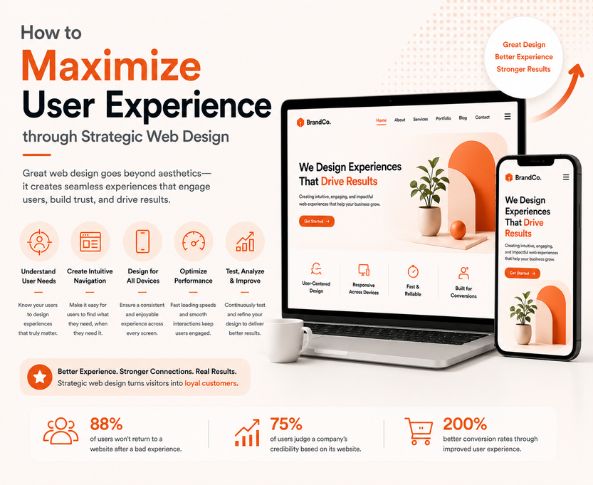
How to Maximize User Experience through Strategic Web Design
16 Jun 2026
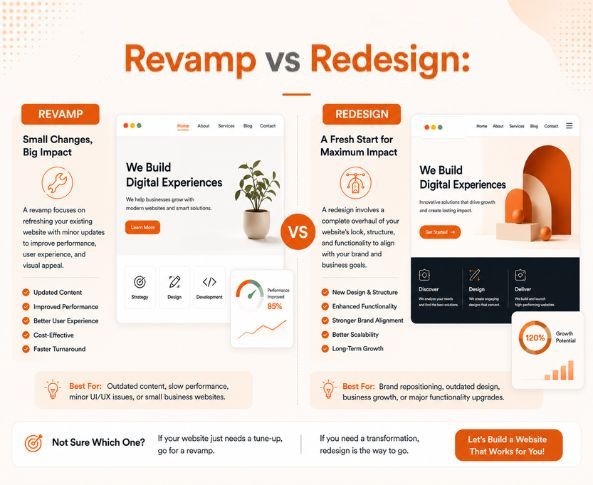
Revamp vs Redesign: Which Does Your Website Need?
27 May 2026
SEO vs Paid Ads: What Should Businesses Focus on First?

23 May 2026
Is Your Website Driving Customers Away Without You Realizing It?
19 May 2026